 22.42°C
Colchester never really leaves Stephen Munson.
The Colchester-born musician and writer – also known as Spaceman – has spent decades moving between Suffolk and France, between small cafés and international stages, but the city where he grew up keeps resurfacing in his work. In poems. In songs. In films. In the names, he still speaks with quiet affection.
It is not really nostalgia. It is something closer to gravity.
“I reinvented myself here”
Munson does not romanticise his younger self.
“I was violent,” he says plainly. “Properly violent. Nasty. No one wanted to play with me.”
At Sir Charles Lucas school, he often fought and pushed people too far. Eventually, Colchester pushed back.
“One day I got beaten up properly,” he says. “And I realised I couldn’t keep being that person.”
That was the turning point.
“I reinvented myself.”
The reinvention was not dramatic. It was gradual. He started reading more. Listening more. Paying attention to things that had not interested him before. If he could not dominate a room physically, he would learn to exist in it differently.
“I decided I’d become intelligent instead,” he says with a small smile. “Or at least try.”
Colchester made that possible.
It was a town full of characters. You could irritate people. You could be awkward or difficult. But you were still from Colchester, and that carried a strange kind of loyalty.
Even rival towns reinforced that feeling. Nights out in Ipswich, Braintree or Chelmsford often carried an edge, but if someone from outside started trouble, the Colchester boys would close ranks.
“You were one of theirs,” he says. “That mattered.”
He still talks about the late 70s and early 80s scene with clarity – Robbie Grey working at Denim City, Modern English gathering pace, bands like Fear of Sex and Swimming In The Sea rehearsing, Musicians like Graham Andrew and Gary Leach moving between projects. Nick Denton stepping in. Colchester seemed to hum with possibility.
“How could you not do something musical?” he says. “Colchester could have produced twenty great bands.”
Looking back, the town gave him something important – friction. And from that friction, he started to understand who he was.
“It’s my Colchester”
Years later, while working on the album 6 Million Miles From Nowhere, Munson began bringing his children back to Colchester.
French kids on holiday in Essex.
“One night in the rain, I took my son for a walk,” he says. “I showed him where I grew up, where old girlfriends lived, all of it. I used to walk those streets with a little radio, listening to pirate stations in the early 70s. I told him it was the best of times.”
Back at the house where he was staying, he wrote a poem about that walk. It became A Guided Tour Of Colchester.
The following day, he bumped into Gilly in town. That turned into another poem – Choc and Gilly. Soon there were more.
His daughter spotted the pattern first.
“She said, ‘Are you writing a book about Colchester?’ And I realised she was right.”
The poems were affectionate, but they were also a kind of reckoning.
“I had to put things straight,” he says. “I wasn’t easy when I was younger.”
Some of the poems are apologies. Others are portraits of people who shaped the town, and his own life.
He still only supports Colchester United. North Hill still carries weight for him.
“Colchester is not perfect,” he says. “It’s got its rough bits and its good bits. But it’s my Colchester. It’s where I was born and bred.”
Living In Texas
Before Spaceman, there was Living In Texas.
The band formed in 1982 and ran until 1991. They released records and EPs, toured widely and experienced the strange mixture of excitement and chaos that follows most young bands.
“We did everything you could do with a band,” Munson says. “Records, albums, touring.”
At one point, they landed in Italy to discover they were charting at number three.
“We didn’t see any money,” he laughs. “But it made us laugh.”
At the centre of it all was Dan Jones.
Munson remembers the moment clearly. He saw Jones walking up North Hill and stopped him.
“I said, ‘I love your style of playing. Would you form a band with me?”
There was a catch.
“I told him he might have to move to London.”
Jones went home, packed his bags and left that day.
Soon, Matt Fraser joined after stepping in for a drummer who had failed to turn up. He stayed. Nick Denton was there. Around them was a town full of musicians, each band feeding energy into the next.
For Munson, though, everything came back to Jones.
“Everything I do – everything I write, everything I compose, everything I film – I still do it to please Dan.”
He says it simply.
“He was the only person who could tear my writing apart, and I’d accept it with a smile. He loved me unconditionally. That’s rare.”
Jones appears on the new EP, The Impossibility of Being Dan Jones. His playing threads through it.
“This is how we keep people alive,” Munson says. “I think about him every day.”
Words and songs
For Munson, poetry and songwriting come from the same place.
“Words are words,” he says. “Poems and songs start in exactly the same place.”
The difference is in structure. A poem carries its own rhythm. A song has arrangement, melody and space around the lines.
He is unsparing in his assessment of his early writing.
“I was ridiculously pretentious,” he says. “I thought what I was writing was brilliant. It wasn’t.”
Over time, he stripped that away.
His respect for lyric writing becomes obvious when he talks about other artists. Through touring, he once crossed paths with Lana Del Rey backstage at British Summer Time. Munson was tour managing a support act whose pianist had played on her record.
Their conversation turned quickly to lyrics.
“I told her the line ‘Better than I ever even knew’ from Video Games – the Beatles would have been pleased with that,” he says. “That’s not flattery. That’s craft.”
Later, they met again in a professional setting, and the subject returned to words.
“‘Love me till I love myself’ – that’s poetry,” he says. “That’s knowing exactly where to stop.”
For Munson, that kind of precision is everything.
He speaks about Martin Newell in the same way – the Colchester songwriter behind Cleaners From Venus. And about Dan Jones.
“Precision matters,” he says. “You have to mean it.”
Spaceman
Spaceman began unexpectedly in a hospital bed in Paris.
Munson had gone to a doctor with chest pains and ended up being admitted for a week of tests. Nothing serious was wrong, but the experience left him thinking.
“My daughter came in to see me,” he says. “She was about five or six. I told her I wanted to start playing music properly again and asked what I should call myself.”
She chose the name, Spaceman.
The name stuck.
Spaceman is not really a character, he says. It is closer to freedom.
At the time, Munson was tour managing major international shows – the Hollywood Bowl, Radio City Music Hall, and tours across Brazil and Australia.
“I’d been around all that machinery,” he says. “And I just wanted to do music for the love of it.”
He started playing small rooms in Paris. No pressure. No expectations.
Australian artist Merryn Jeann eventually pushed him to record. Along with French producer Etienne Tricard, she was starting a label and wanted to release the songs.
Munson agreed on one condition – Christelle Canot, aka CONFUSE, would produce the recordings.
“She arranges everything and records everything,” he says. “Because of her, I think I now make beautiful music.”
Around thirty songs were recorded. Twenty-five ended up on a double album released in 2022. Videos followed, filmed in places including Colchester, West Mersea, Finchingfield, Marseille and Paris.
He understands the difference between instinct and technical mastery.
“I admired someone like Reg Webb (RIP) enormously,” he says. “That level of musicianship is incredible.”
But he is not trying to compete on those terms.
“I’m not a great technical musician. I know that. What I can do is write a song.”
At one point, he even found himself opening a show in France in front of twenty thousand people.
“The audience barely noticed,” he says. “I had a big smile on my face.”
Why?
“Because I’ve got nothing to lose.”
The new EP continues that approach. Munson covers artists he loves – including Martin Newell, Dogbowl, Dan Black and Holden – and brings them directly into the recordings and videos.
“I wanted the pressure,” he says. “I had responsibility to those songs.”
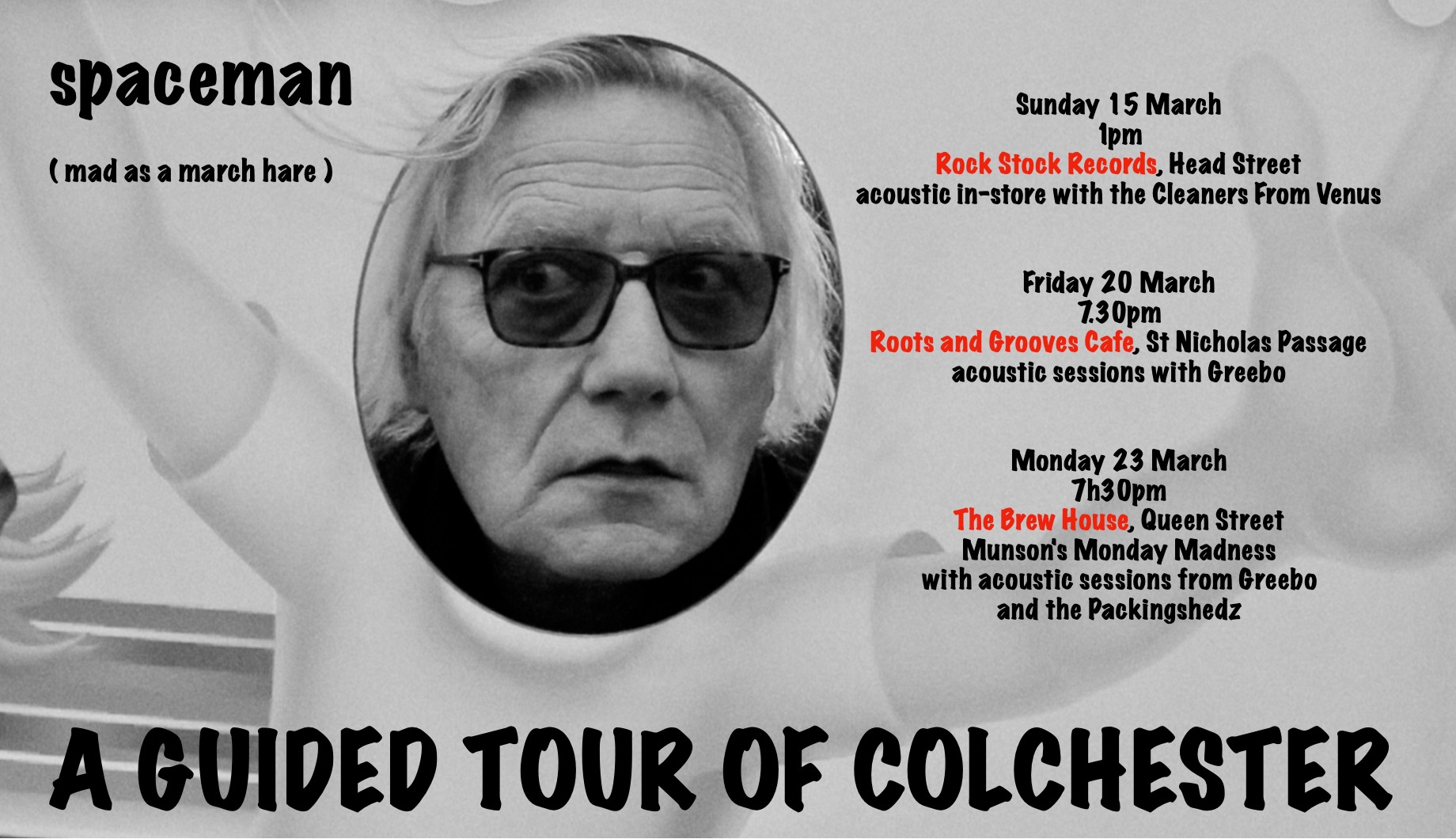
A Guided Tour Of Colchester
The idea for the European café shows eventually circled back to Colchester.
“If I’m going to tour anywhere properly,” he says, “why not here?”
The Guided Tour Of Colchester became three shows in ten days: Stone Rock Records, Roots and Grooves Cafe, and the Queen Street Brewhouse.
Local musicians are involved, including members of Greebo.
He is not taking the idea of a tour lightly.
“I just like the idea that I don’t have to get on a bus,” he says. “I can walk.”
The last large-scale show he played – at David Lynch’s Silencio club in Paris – left him cold.
“There was too much around it. Too much industry.”
What he wants now is something simpler.
“I want it to feel like my front room. Like people have just turned up while I’m playing.”
There is even talk of a Monday residency at the Queen Street Brewhouse.
“Because nobody’s got anything on a Monday.”
After everything – the touring, the albums, the years away – returning to small rooms in Colchester does not feel like going backwards.
It feels right.
And this time, Stephen Munson really does have nothing to lose.
A Guided Tour Of Colchester – Dates
Munson’s local run of shows takes place across three venues in March.
Sunday 15 March – 1pm
Stone Rock Records
Acoustic in-store session with Martin Newell/Cleaners From Venus
Friday 20 March – 7.30pm
Roots and Grooves Cafe
Acoustic session with Greebo
Monday 23 March – 7.30pm
Queen Street Brewhouse
Munson’s Monday Madness with acoustic sessions from Greebo and The Packingshedz