 22.42°C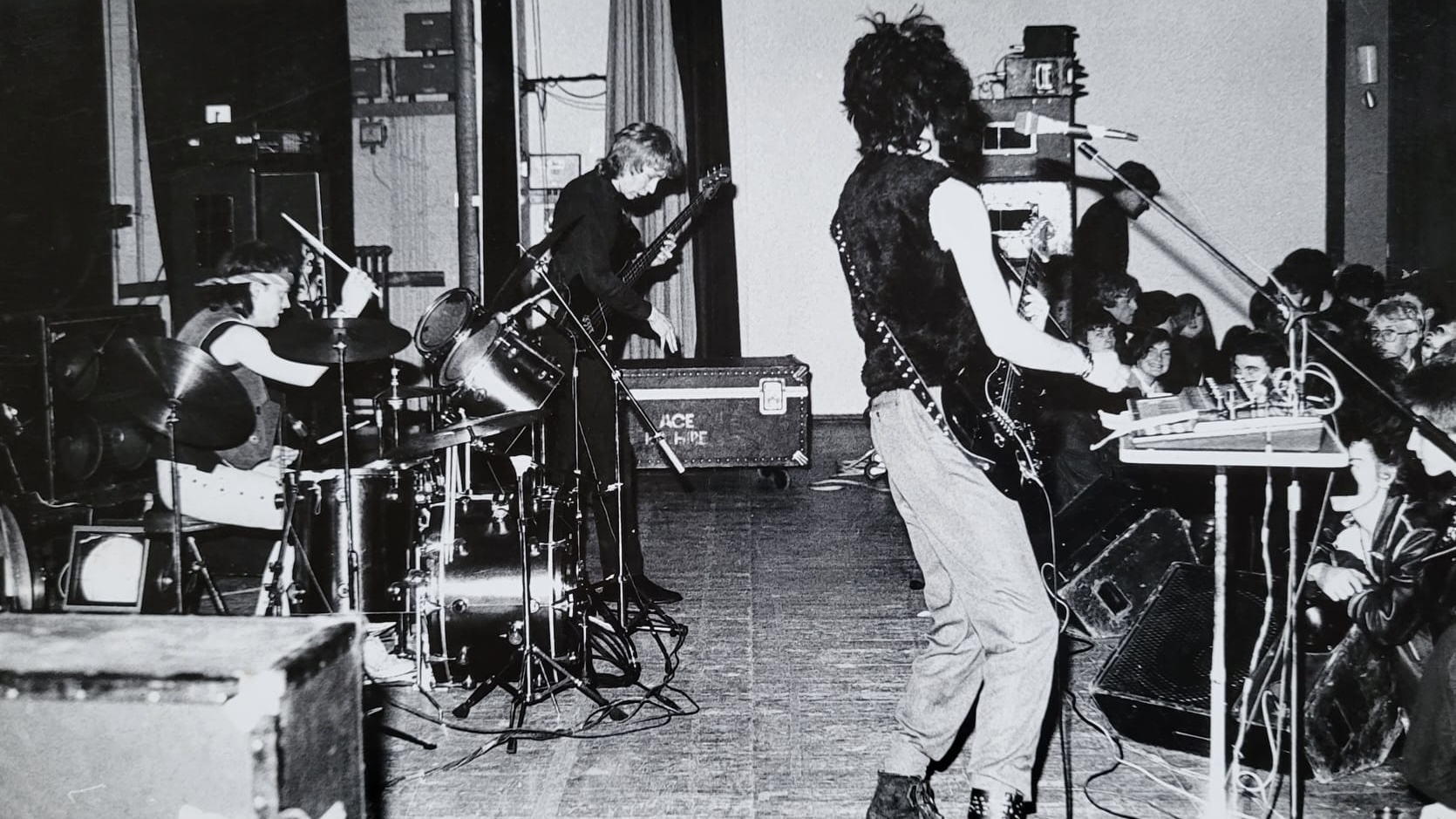
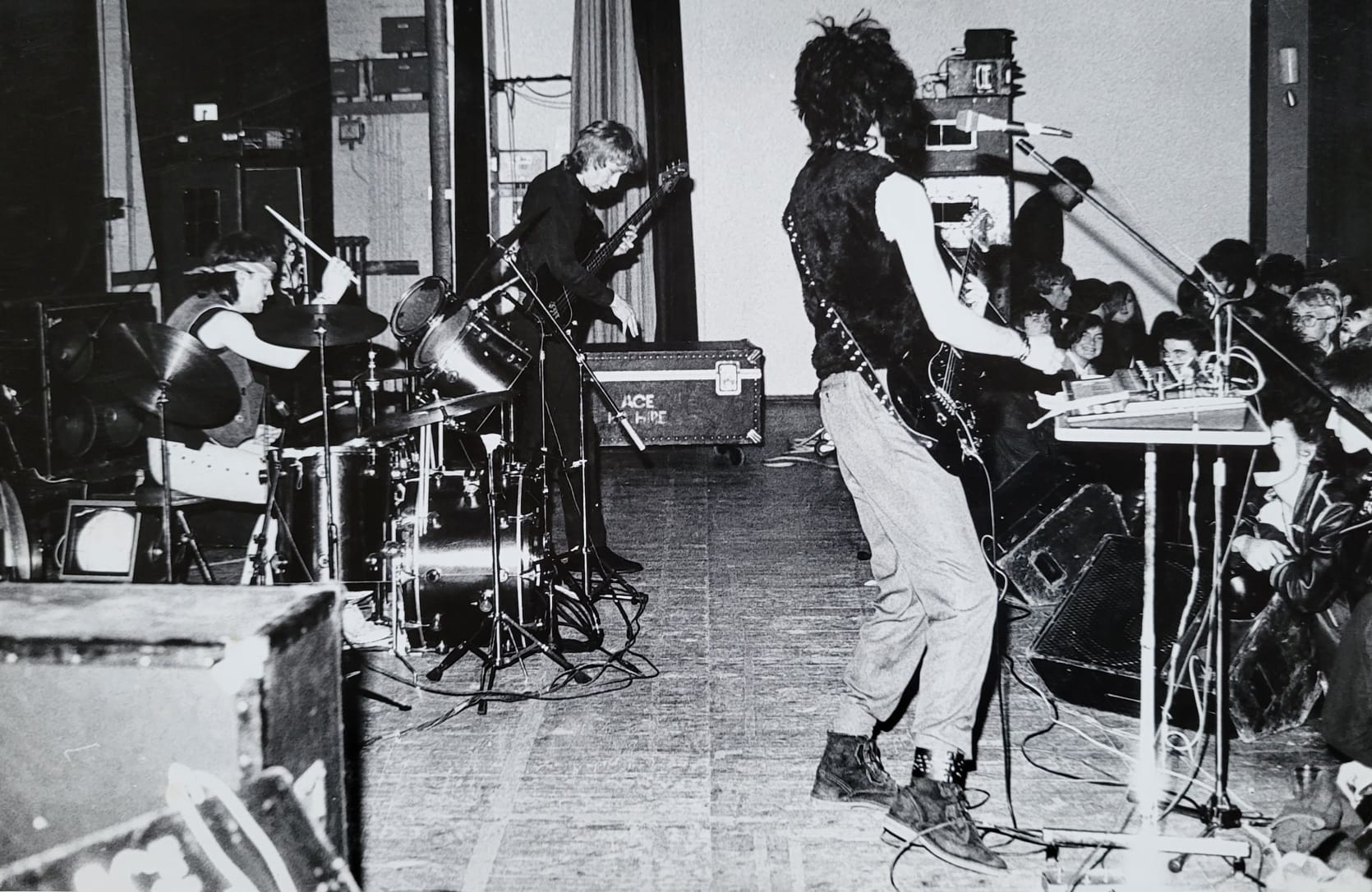
Three Times A Day were one of the most distinctive bands to emerge from the Colchester music scene in the early 1980s. With Huck temporarily back from Australia, Nel, Johnny and Huck sat down with Keep Colchester Cool’s Ben Howard to discuss how the band formed, the gigs they played and the places that shaped those years.
Huck’s visit back from Australia felt like the right moment to talk properly about Three Times A Day again. Not just the dates and the flyers, though those still exist somewhere, or the cassette sleeves and rehearsal tapes that occasionally surface in old boxes. What mattered more was hearing the stories again in the way band memories always work. Someone begins describing a gig or a rehearsal, someone else interrupts with another detail, and suddenly an evening from forty years ago feels as though it has just happened.
Three Times A Day were part of a wider Colchester music scene that was busy, curious and surprisingly interconnected. Musicians moved between bands, watched each other play and talked constantly about records, gigs and ideas. For a few years, Three Times A Day sat right in the middle of that.
As Nel, Johnny and Huck talk, the same names, venues and stories keep resurfacing. The Colne Lodge. Guisnes Court. The Affair. Essex University. Forty years later, the details are still there.
The story is not just about the band itself, but about a particular moment in Colchester’s musical life – when original bands were forming constantly, venues were willing to give them space to play, and audiences were curious enough to show up and see what happened.
The Colne Lodge beginnings
Like many bands of that period, it started in a pub.
In the late 1970s, the Colne Lodge on Crouch Street was one of the places where musicians naturally drifted. People met there after work, talked about music, and swapped stories about bands they had seen or were trying to form. That was where Nel and Johnny first properly connected.
Nel already had experience from earlier bands. Before Three Times A Day, there had been Copraphile, which he remembers as a three-piece before it expanded. Like many Colchester groups of the time, the line-up overlapped with other bands in the area. Richard Brown, who later went on to Modern English, had played drums in one version of Copraphile. Pete Brown, who would later become the first bass player in Three Times A Day, would also go on to play in other local bands, including Reasonable Strollers and, later, Salad.
Johnny had been unemployed since leaving school in 1977 and was living at home in Colchester, but he was determined to play drums in a band that felt serious and creative. During that same time, Nel was working at Woods Air Movement, while Johnny later found work at Parrot Records in December 1979 – a job that would later become another link between the band and the local music community.
Johnny had played in bands before as well, but he was looking for something more interesting than the covers outfits he had previously been part of.
“You meet in the pub, talk about music and realise you’ve got things in common,” Nel says. “Then someone says, ‘Why don’t we have a jam?'”
That jam became the band.
A band name from a toothpaste box
The name came in a way that still makes them laugh. Nel remembers noticing the phrase “two or three times a day” on the back of a toothpaste box. Something about it stuck in his head. It had that slightly odd mixture of being completely ordinary and strangely memorable. Everyone recognised the phrase, but it was not something you expected to see on a gig poster.
The band liked that immediately.
There was another side to it that amused them at the time. As Nel admits now with a grin, phrases like that carried a slightly cheeky meaning when you were a group of young men in your twenties.
Either way, it stuck. It beat some of the alternatives floating around during those early discussions. One suggestion they remember with particular relief was Starz.
Rehearsals in Fingringhoe
Through local connections, they linked up with bass player Pete Brown, and Pete’s parents’ house in Fingringhoe became the band’s rehearsal base.
In practical terms, it could hardly have worked out better. The house was detached and slightly out of the way, which meant they could make as much noise as they liked without immediately upsetting neighbours. Pete’s parents were also remarkably tolerant about the idea of a band rehearsing in the house.
“They were very easy going,” Nel remembers.
They rehearsed in a dining room with large picture windows overlooking the river, with Wivenhoe visible across the water. At the time, there were no rehearsal studios they knew about, and certainly none they could afford.
So, they rehearsed constantly.
Johnny remembers how seriously they took those sessions.
“That’s what made us really good,” he says.
Songs were dismantled and rebuilt repeatedly during those rehearsals as the band experimented with arrangements and sounds. Ideas were tested, discarded and then rebuilt again until they felt right.
Influences and finding their sound
Those rehearsals were where the band discovered what it sounded like. Musically, they were pulling influences from several directions at once. Hendrix was an obvious reference point, as were the Groundhogs, but they were also listening closely to the newer sounds emerging at the end of the 1970s. Bands like XTC, Siouxsie and the Banshees and The Cure were all part of the conversation.
That mixture pushed the band in unusual directions.
“I really liked being different,” Nel says. “If something sounded different from everything else, that’s what interested me.”
Early rehearsals included a mixture of covers and original songs. Hendrix’s Fire appeared in the set, along with Staircase Mystery by Siouxsie and the Banshees, but gradually their own material began to dominate.
The Colchester scene and early gigs
Their first gig came at Essex University, outside the Student Union bar. It was hardly the most dramatic debut imaginable. Students wandered in and out while the band played.
“Totally terrified,” Johnny remembers.
But Essex University mattered. It was one of the few places where original bands could actually play to larger audiences. It was also a place where musicians from other bands would show up to watch.
Geoff Lawrence was around. Steve Linton was around. The Colchester scene was beginning to form.
During the band’s early period, the bass was played by Pete Brown. After Pete left, Huck joined the band on bass, following a recommendation from Hob, the bass player in Copraphile, and quickly became a central part of the band.
Huck remembers that atmosphere clearly.
“It felt like there were loads of bands around,” he says. “But it didn’t feel like competition. Everyone was just trying to do something interesting.”
Certain venues became central to that scene. One of the most important was Guisnes Court in Tolleshunt D’Arcy. It was awkward to reach and usually required a lift, but it gave original bands somewhere to play and experiment. The room itself was unusual, more like a large living room with a bay window than a conventional venue.
“That’s where we cut our teeth,” Nel says. “That’s where we made the mistakes and refined what we were doing.”
Back in Colchester, The Affair became another regular stop. It was small, crowded and intense, with the audience standing right up close to the band. Nel remembers the promoter telling them they were one of the few bands she could rely on to pull a crowd.
Playing Colchester Arts Centre
Another venue that stood out was Colchester Arts Centre. Compared with the smaller clubs and pubs they had been playing, it felt different immediately.
“It felt like a proper venue,” Nel says.
There was a stage, lighting and an audience who had come specifically to see live music rather than simply happening upon it. For a local band used to squeezing into corners of pubs or improvised spaces, the Arts Centre carried a different kind of atmosphere.
London gigs and the Guy’s Hospital show
Around this time, the band also began travelling further afield. Having built a reputation locally, they started picking up gigs in London and elsewhere while continuing to perform around Essex. Among the venues they reached were the Fulham Greyhound, the Rock Garden and the Moonlight Club in London – all important and well-known stops on the independent circuit at the time.
One of the most memorable London shows took place at Guy’s Hospital, organised by Johnny’s sister. Friends travelled up from Colchester to see them, and there was a growing sense that the band was gaining momentum.
The night ended in a way none of them expected. During the encore of Approximately 1:08, Johnny badly injured his back behind the drums.
“It was the worst timing imaginable,” he says now.
The band had to cancel their next scheduled gig at St Mary’s Arts Centre while he recovered.
When they eventually returned to the stage at the Embassy Suite in Colchester, Johnny was still wearing a back brace.
“As far as I was concerned,” he says, “it was do or die.”
Studio sessions and the Storm single
Eventually, the band caught the attention of Edward Christie, who had recently left his job at GEM Records to start his own label, Abstract Records.
Through local connections, he became aware of Three Times A Day and asked to hear some recordings. Nel and Johnny travelled to London to meet him and discuss the possibility of recording a single. Christie was enthusiastic and suggested bringing in Nicky Garratt from UK Subs to produce the session.
The result was a trip to Gateway Studio in London.
For a band used to rehearsing in houses and small rooms around Essex, recording in a proper studio felt like a significant step forward.
“It felt natural,” Johnny says.
The band recorded three tracks: Storm, I Crave to Be a Hermaphrodite, and X-ray. The session quickly became more experimental than they had expected.
Nel was asked to sing directly against a sheet of glass to capture a particular vocal sound. Johnny recorded a separate hi-hat track for X-ray. Tape loops were used to create thunder and lightning effects for Storm.
Getting the lightning sound right proved to be something of a challenge. The band wanted the second lightning strike to sound different from the first.
Eventually, the engineer solved the problem by placing corrugated metal outside during a rainstorm and recording the rain hitting it.
One of the microphones was apparently close enough to the toilet that it also briefly captured one of them going for a pee.
Still energised by the experience, the band soon travelled to Octopus Studio near Stowmarket to record additional demo material with engineer Dave Hoser.
The single was released on 16th October 1981.
Originally, Storm had been planned as the A-side, but Edward Christie decided that I Crave to Be a Hermaphrodite would make a stronger statement.
Looking back now, all three are slightly surprised by how quickly things happened. Within a relatively short period, they had gone from those first rehearsals to recording in London, releasing a single and travelling around the country playing gigs.
Momentum, changes and the later line-ups
Having a record out helped them secure more gigs, but life as a band was rarely glamorous. Once petrol, van hire and equipment costs had been paid, there was rarely anything left.
“You never made any money,” Johnny says.
Even so, the band kept moving forward.
“We were on a roll,” Nel says.
They were also producing cassette releases – a common format for independent bands at the time. Tapes circulated through gigs and local record shops, including Parrot Records, where Johnny worked.
The band’s growing profile also brought opportunities beyond the local circuit, including an appearance connected to the John Peel Roadshow – another sign that they were beginning to reach audiences beyond Colchester.
One of the biggest turning points came when Huck decided to leave the band.
For Nel and Johnny, it came as a shock.
“I just thought, how can you leave something this good?” Nel says.
Despite his departure, both Nel and Johnny remain quick to acknowledge how important Huck had been to the band’s development.
“Huck was a huge part of it,” Johnny says. “The way he played bass shaped the band.”
Nick Sadler from Snide Remarx joined on bass, bringing a new energy to the line-up. Mary Kitson joined the band on saxophone after teaching herself the instrument specifically for the band.
The addition of Mary on saxophone took the band somewhere different again and gave the later line-up a very different feel from the group that had recorded Storm a few years earlier.
With that line-up, the band entered one of its busiest periods. They were playing regularly across Essex and Suffolk, including Chelmsford, Maldon and Ipswich, while also travelling further afield to Brighton and London. They continued to develop new songs and release cassette recordings.
One show from this period became memorable for another reason. A mobile recording van from Sound Advice turned up and asked if it could record the gig. The resulting live recording captured the band at a point when the line-up had evolved significantly from the group that had first emerged from those early rehearsals in Fingringhoe.
By 1984, other pressures were beginning to appear as well.
The final gig at the Colne Lodge
Johnny was finishing his archive conservation course at the Colchester Institute and already knew that he would soon be leaving the town for work.
The band decided the best way to finish was to return to where it had all begun.
The final gig took place in October 1984 at the Colne Lodge.
Friends, musicians and familiar faces from the Colchester scene were there. It was not advertised as a big farewell show, but people seemed to understand what it represented. After several years of rehearsals, gigs, recordings and changing line-ups, the band were back in the same pub where the idea had first started.
Most importantly, all went to plan.
“We played really well,” Johnny says.
Sitting with Nel, Johnny and Huck now, it becomes clear that those years still sit very close to the surface. Those early rehearsals, the strange studio experiments, the gigs that worked and the ones that nearly fell apart – the details come back quickly once the conversation starts.
For those years, Three Times A Day were part of a lively network of bands, venues and people that made up the Colchester scene. They rehearsed constantly, wrote their own material and travelled wherever they could find a stage. Listening to them talk about it now, you realise those experiences still matter to them – not as nostalgia, but as something they believed in and worked hard to build together at the time.
And sitting there listening to them talk, you realise that the belief they had in the band back then is still there. So is the pride in what they achieved together.