 10.96°C
 Simon Craze’s new album, Let Him Have It, completes Input-Process-Output, a three-album project that has occupied much of the last five years of his life.
The trilogy spans a period that included major events and changes in his life. Looking back now, Simon sees the three albums as both a record of that time and a way of making sense of it.
“It was a period of time that I knew was going to be difficult,” he says. “It ended up being a coping mechanism for myself, but also I wanted to have something to show for it and to have something positive come out of it all.”
The phrase Input-Process-Output came from Simon’s former career as a technology teacher.
“It’s a phrase I had to say a lot. Something goes in, something happens, and then there’s an outcome,” he says. “I’m always just in one relentless moment. The way I process things, I need time to retrospectively look at them.”
That idea sits at the heart of the trilogy.
Simon compares it to picking up a stone from a beach. For some people, it is simply a stone. For some, it can unlock an entire memory.
“I remember the smells, what the weather felt like, who I was with, what I could hear. There’s so much in that one thing.”
The albums became a bit like that stone – something he could return to later and look at from a different perspective.
“What I wanted from this was to have something I can look back on and reflect on,” he says. “It’s been good to have something to focus on.”
The first album, Live from Limbo, was written while Simon was caring for his father. He found himself spending evenings writing and recording at home.
“Me and Mum would put Dad to bed, and I would find myself picking up my guitar,” he says. “I’d written a couple of songs and thought maybe I could get an album’s worth of stuff together.”
The album was made largely with whatever equipment he had available.
“I couldn’t afford to record a full band album,” he says. “I thought, don’t make it perfect, just make it exist first; I can make it better later.”
Rather than seeing limitations as a reason not to make the record, Simon embraced them. A cajón became the drum kit. A box of Tic Tacs became a shaker. Songs were recorded on a simple eight-track recorder.
It is an approach that keeps coming up when Simon talks about making things.
During lockdown, he spent months building a puzzle box modelled on his house. As a technology teacher, he often encouraged pupils to work within creative constraints rather than stare at a blank sheet of paper.
“If you give people infinite possibilities, they often don’t know where to start,” he says. “Give them a few starting points, and it becomes easier to be creative.”
The same idea found its way into his songwriting. One song began after he rolled a pair of dice to decide where a capo should sit on the guitar neck and on how many strings. Another started as a collection of unrelated musical fragments recorded into his phone while walking or travelling.
“Rather than thinking about what I couldn’t do, I tried to think about what I could.”
“The first album was the input,” he says. “It was the first raw thing. I’m in this, just trying to do what I can.”
The second album, Mosaic, arrived during his father’s decline and eventual passing.
“I think I was getting better in a lot of respects,” he says. “I had an amazing partner, and my kids were settling into their new normal. That made space for me to reflect on the impact of everything the first album was about, as well as what was happening at the time.”
Looking back now, Simon sees a clear progression across the trilogy.
“The first one has a degree of confusion,” he says. “The second one is reflecting on the impact of those things. The third one is trying to go, okay, so what’s next?”
That final album, Let Him Have It, shifts its attention towards the people who helped him through.
“Ultimately, the people in my life have been absolutely phenomenal,” he says. “I’d be nothing without them.”
Family runs through all three albums. Every record includes a song written for his sons.
“It’s only really now, looking back, that I realise that some parts are as much about my sons and me as they are about my dad and me, and vice versa”, he says.
“I’m a bridge between two different worlds. I was struggling with seeing my sons a lot less, and I was struggling with the fact I was going to be seeing my dad a lot less.”
The songs changed as his children grew older.
“The first one was about enjoying the time I do have with them instead of focusing on the time I don’t.”
“The second one was almost an apology from my generation. The third one is about them moving forwards and how I hope they expect to be treated.”
Music has been part of Simon’s life since childhood. He played in bands as a teenager, but singing was the breakthrough.
“The first time I sang, I found my roar,” he says. “It was such a freeing feeling.”
More than twenty years later, music remains one of the ways he is most comfortable expressing himself.
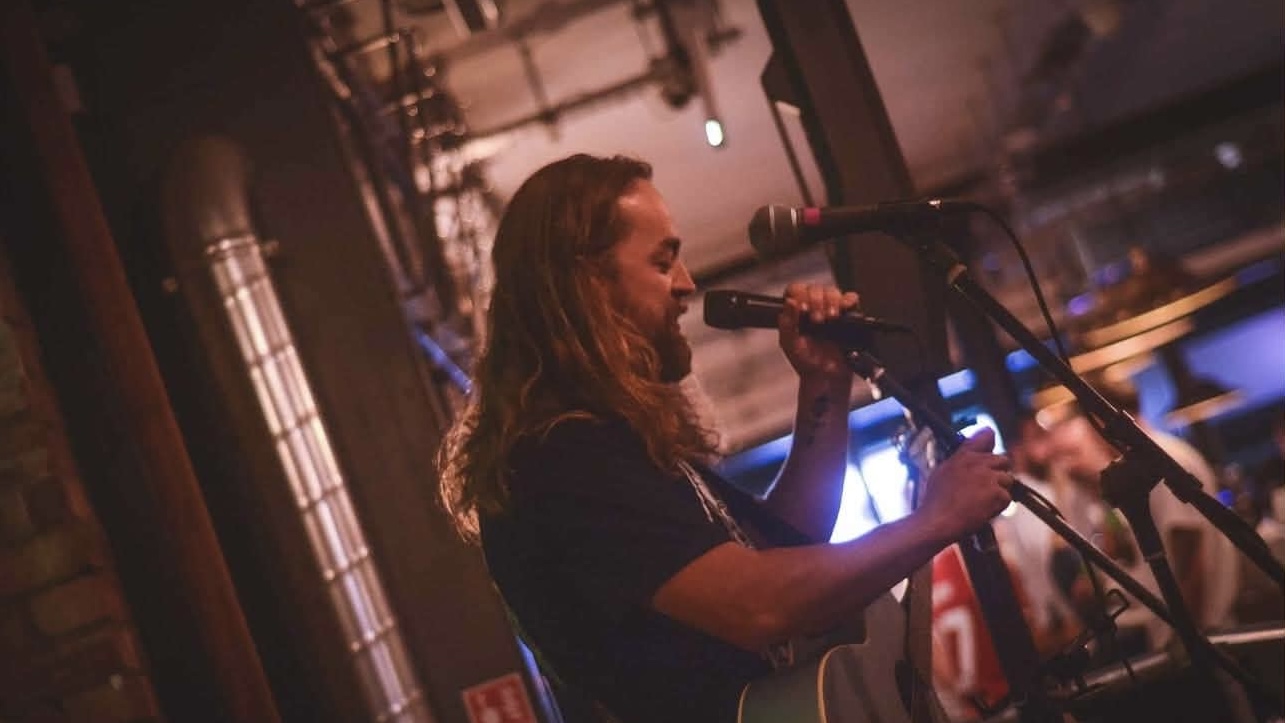
Anyone who has seen Simon perform at venues such as Colchester Arts Centre, Queen Street Brewhouse, Coda or one of the city’s open mic nights may find it surprising to hear him describe himself as shy. On stage, he has a warmth and authenticity that quickly win over audiences.
Away from the microphone, however, he describes himself very differently.
During our conversation, he laughs about avoiding eye contact with people and admits social situations can still feel overwhelming.
Music provides a different kind of space.
“It’s a really freeing feeling,” he says.
Simon prefers to write about emotions rather than specific events or experiences.
“If I write about a broader feeling rather than a specific thing, hopefully more people can find themselves in it.”
Songwriting itself remains instinctive. Simon always starts with music rather than lyrics.
“If you put a piece of music together, that’s coming from you, and it’s a reflection of how you’re feeling in that moment,” he says.
“Even if I don’t know how I’m feeling, what naturally comes out is an emotion. For me, I find the right words come easier once the music is there.”
Over the course of the trilogy, he feels he has become more confident in trusting those instincts.
“I’m not second-guessing myself as much,” he says. “I’m using fewer notebooks. I’m just going for it.”
The making of Let Him Have It took longer than Simon originally planned. At times, that was frustrating, but he now believes the album benefited from the extra time.
He began performing some of the songs live long before recording the final vocals.
“I’d been singing them for almost a year,” he says. “That helped refine them.”
The extra time also allowed him to experiment more with arrangements, rhythms and hidden details within the recordings.
One song in particular captures where he finds himself now.
“Hubble Bubble is probably the main one,” he says.
“It’s about your place in the grand scheme of things. That we have a responsibility to care and be kind. The main thing that has got me through pretty much everything is my family, my friends, my partner and my kids. It’s appreciation of that really.”
Although the trilogy is now complete, Simon says it still feels slightly unfinished until the album is physically in his hands at the end of the month.
“I’m looking forward to a sense of closure,” he says. “To put everything into a box and then I can open that box in my own time and look through it.”
While Input-Process-Output was largely driven by Simon’s own songwriting and recording, the project was not created entirely in isolation. As the trilogy developed, he increasingly worked with Liam Hooker at Black Cactus, who mixed the albums and helped him better understand the recording process with each one.
Having completed the trilogy, Simon is keen to build and explore new ideas with other local musicians.
One possibility already being discussed is a series of informal sessions with Hooker.
“Liam and I are going to do some stuff and just see what happens,” he says.
The wider Colchester music scene has also played an important role.
“The Colchester music scene is amazing,” he says. “It’s supportive. It’s beautiful.”
After five years spent building Input-Process-Output, Simon is looking forward to whatever comes next.
“I never know what comes next,” he says. “I don’t know what it is, but I’m excited about it.”
Let Him Have It is released at the end of June, and Simon will mark its arrival with a performance at Colchester Arts Centre on Friday 26th June, alongside Gasoline Green and Tom Corbyn. Tickets are on sale now.